How to Pick Your First Generative AI Project That Actually Delivers
Starting with the right project makes all the difference
Generative AI is no longer a curiosity. It is a practical tool that can change how work gets done. But the first project a team chooses can determine whether the technology becomes a regular part of their workflow or gathers dust after a single trial. The key is not to look for the most impressive demo. It is to find a real problem that generative AI can solve cleanly, with a clear measure of success.
For professionals attending an AI application development course, the goal is to leave with something that works. A simple generative AI application built over two days must be focused. That means choosing a use case that is narrow enough to finish, but valuable enough to justify the effort. The following points form a practical checklist to guide that choice.
Check that the task is a repetitive one
Generative AI excels at tasks that follow a pattern. Drafting standard replies, summarising meeting notes, reformatting data, generating routine reports - these are the kinds of activities where a model can learn the shape of the output and produce it reliably. If the task changes every time, or depends on unpredictable human judgment, it is probably not a good first project.
Look at the daily work of your team. Which tasks do people do over and over? Which ones involve reading something, writing something similar, or translating between formats? Those are the candidates. A repetitive task has a predictable input and a predictable output, even if the content varies. That predictability makes it possible to build a small generative AI application that handles the bulk of the work, leaving only the final check to a person.
Make sure you can define the input and output clearly
A generative AI model needs a prompt and an expected shape for the answer. If you cannot describe what goes in and what should come out, you cannot test whether the application is working. A clear specification also helps you choose the right model and write the right instructions.
For example, if the task is to turn a phone call transcript into a list of action items, the input is the transcript text and the output is a bulleted list with owner and deadline. That is precise. Compare that to a vague goal like "improve customer communication" - it is too broad to build a single application around. A good first project has a narrow scope. The input is a document, a message, or a structured form. The output is a revised version, a summary, or a set of suggestions. Anything else can be added later.

Check that the process owner is on board
Every business process has someone who owns it. That person knows the details, the exceptions, and the pain points. Without their support, a generative AI project will fail regardless of how good the technology is. The process owner can provide real examples for testing, explain what a good output looks like, and help decide when the output is good enough to use.
In a two-day course setting, you cannot afford to spend time guessing at requirements. The process owner should be able to sit with the team for part of the session, review early outputs, and give quick feedback. Their involvement turns a theoretical exercise into a practical tool that someone will actually use. If no one claims ownership of the task, pick a different one.
Estimate the return on effort honestly
Not every automation is worth the time it takes to build. A task that takes five minutes a week might not justify a full day of development. A task that takes an hour a day, on the other hand, can free up significant time over a year. But the return is not only about time saved. It can also be about quality, consistency, or the ability to handle more work without hiring.
Consider the frequency of the task, the time it takes, and the cost of a mistake. A generative AI application that drafts routine emails might save a few minutes per message. If the team sends dozens of such messages daily, the savings add up. The same logic applies to reports, data entry, or any structured writing task. Estimate conservatively. A small but real saving is better than a grand promise that never materialises.
Look for automation potential without high risk
Generative AI is not perfect. It can produce plausible-sounding but incorrect answers. For a first project, avoid tasks where a mistake would cause serious harm. Sending a wrong price to a customer, misinterpreting a legal clause, or generating inaccurate medical advice are all high-risk uses. Leave those for later, when you understand the model's limitations and have built safeguards.
Good first projects are those where the output can be reviewed quickly by a person before it is used. Drafting, summarising, and reformatting are low-risk because a human can spot errors in seconds. Tasks that involve direct customer-facing output without review are higher risk. Choose the low-risk path for the first attempt. The experience you gain will make the high-value, high-risk projects feasible later.
A useful framework for assessing automation potential is to map the workflow. Where are the handoffs between people? Where does information get reformatted or rewritten? Those handoffs are often where generative AI can slot in. And because the work is already being done by people, the quality bar is a human one, not a perfect one. An 80 percent solution that saves time is often welcome.
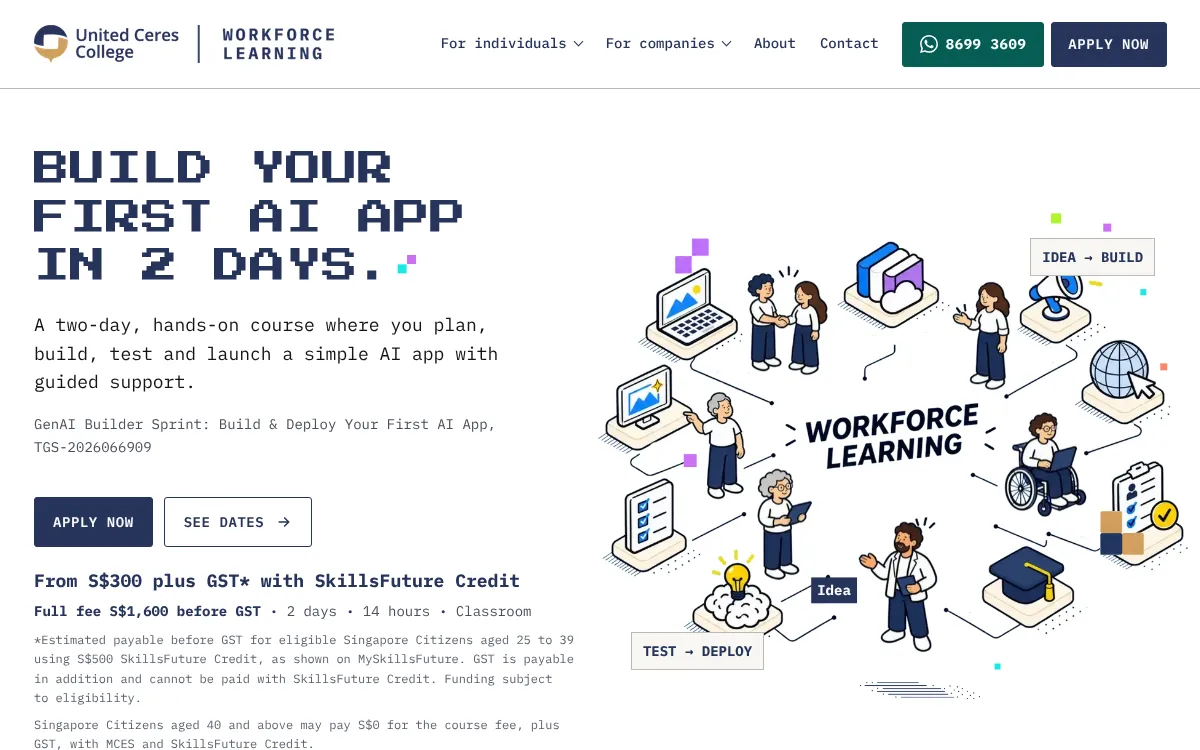
For professionals looking for a structured way to turn these ideas into a working application, the course at workforcelearning.unitedceres.edu.sg offers a two-day classroom format that walks through exactly this kind of project selection and build. The curriculum is built around a simple generative AI application that participants can complete and deploy. The checklist above aligns with the approach that course takes: start small, focus on a real business process, and get a working result fast.
Test with real data from day one
A common mistake is to test a generative AI application on a perfect example that the team wrote themselves. That will work every time. The real test comes when the application faces the messy, inconsistent data that exists in the actual workflow. Typos, abbreviations, mixed languages, missing fields - these are the realities of business data. If the model cannot handle them, the application will not be used.
Gather examples from the actual process owner. Use the real emails, real reports, and real conversations. If some examples are confidential, anonymise them. The goal is to see how the model behaves on the full range of inputs, not just the tidy ones. A few rounds of testing with real data will reveal whether the task is truly suitable for generative AI or whether it needs more human judgment than expected.
Plan for the handoff back to the user
A generative AI application does not replace the person. It changes what the person does. Instead of writing the first draft, they review and edit one. That shift requires the output to be in a format they can work with easily. A long paragraph of generated text may be harder to edit than a structured template. Consider how the output will be used. Will it be copied into an email system? Pasted into a report? Stored in a database?
Design the output format to match the next step in the workflow. If the user needs a bullet list, generate one. If they need a short paragraph, keep it concise. The smoother the handoff, the more likely the application will be adopted. The course at workforcelearning.unitedceres.edu.sg covers this integration aspect as part of its curriculum, so participants learn not just how to build the model but how to fit it into an existing process.
Keep the scope small enough to finish in two days
A two-day course is a tight window. The project must be completable within that time, including testing and deployment. That means no custom model training, no complex multi-step pipelines, and no integration with five different systems. A single prompt, a single input format, and a single output format. That is enough. Once the first project is live, you can iterate and expand.
The best first generative AI project is one that solves a real but contained problem. It uses the model's strengths - pattern recognition, language generation, summarisation - without relying on perfect accuracy. It has a clear owner, real data, and a simple output that someone will actually use. That combination turns a classroom exercise into a workplace improvement. And it builds the confidence to tackle bigger projects next.